The process
Built in order: spec, system, screens, code.
CourtBet had no team to hand off to, which made discipline more important, not less. I ran it like a product, not a mockup collection.
It started as a patent application, not a wireframe. An AI-driven arbitration platform: real disputes resolved in scheduled, livestreamed episodes, an AI judge issuing verifiable verdicts, an audience predicting outcomes. Rigorous on paper, and unlaunchable as described. Nobody wakes up wanting arbitration.
Strip the legal language and look at the mechanics: two people arguing, a verdict, a crowd with skin in the game, all live. That is not a court. That is Judge Judy meets a prediction market on Twitch. The product was never arbitration with entertainment on top; it is entertainment with a judge inside. Every design decision on this page flows from that sentence.
Three calls before any screen. Launch as a prediction game, not a court, because "can you predict how the AI rules?" is an invitation and "submit your dispute" is a chore. Free points only, because the fun is being right and real money buries a new product in friction. And scheduled Court Nights, because an empty platform needs a next show more than it needs features.
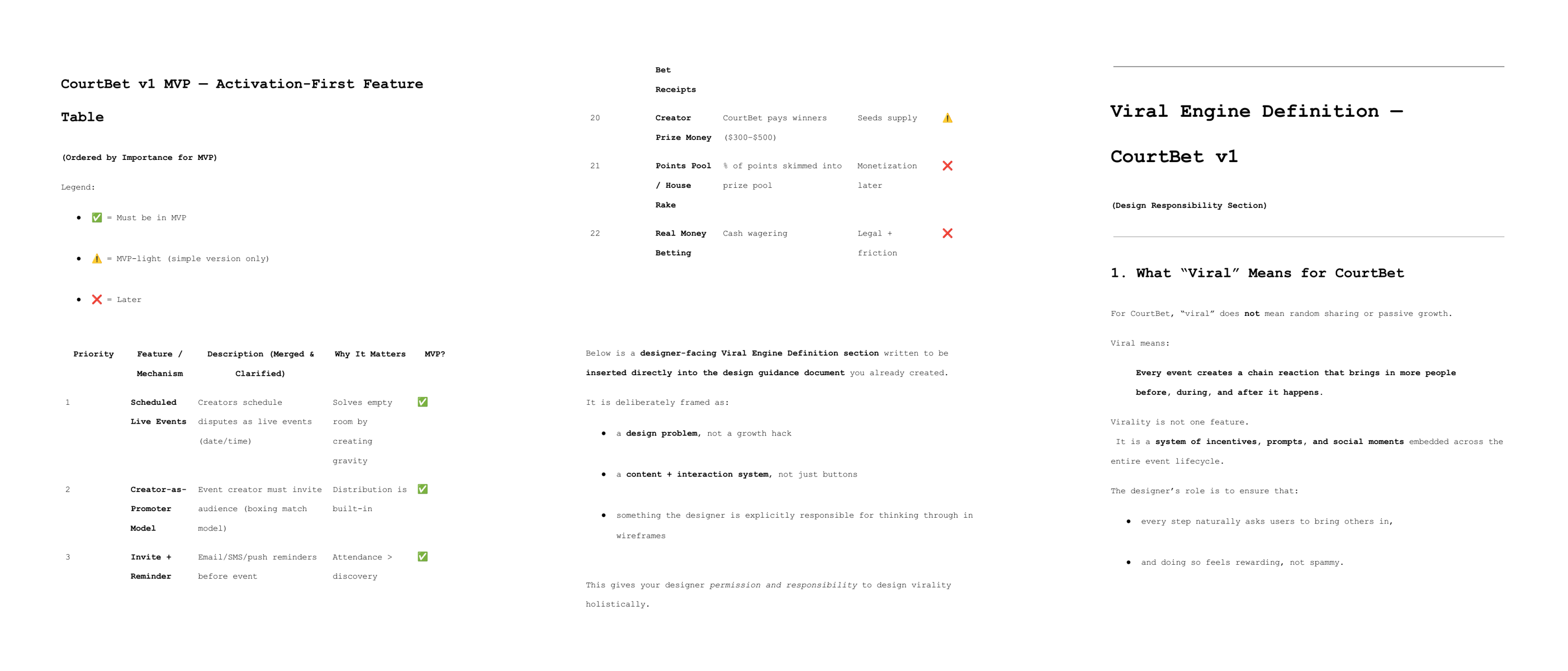
A ruthless MVP spec
Every feature idea went into a prioritized table: must-have, light version, or later. Real-money betting was cut on day one. Attendance beat discovery.
Tokens before screens
Colors, type, and spacing became a token file and a documented component library before the first screen existed.
States, not pages
44 screens covering the moments most designs skip: empty accounts, ended events, guests, and every way a bet can end.
Prove it works
I built the debate room for real: live video, real-time transcription, and an AI judge scoring with a rubric I wrote.
Feature 01 · Foundation
Every color has a job.
A dark, broadcast-style design system where color carries meaning: blue belongs to the AI, gold to points, green to confirmation, red to anything live.
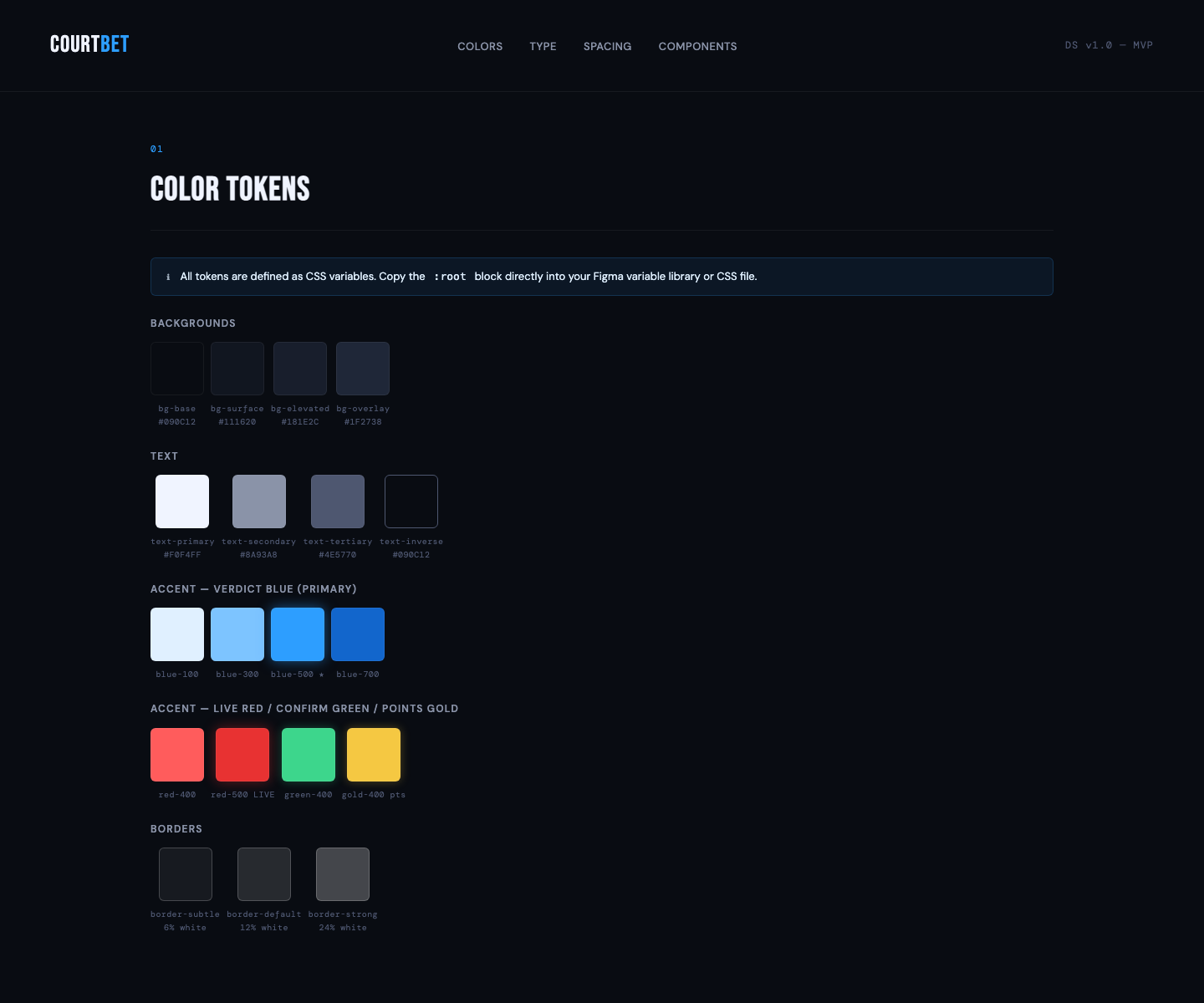
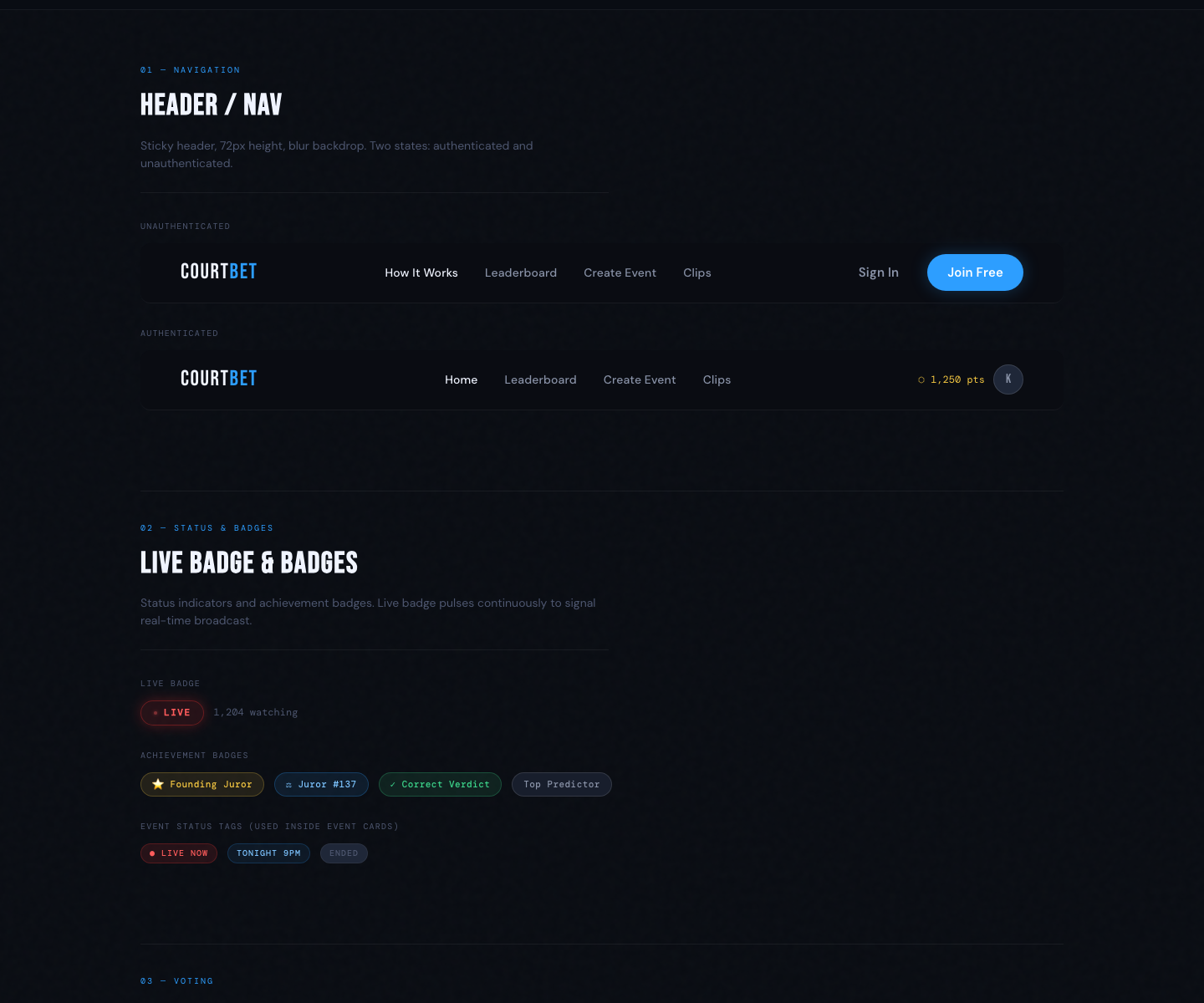
Semantic color, strictly enforced. The AI verdict bar is the only thing that gets the primary blue, so when the bar moves, your eye already knows who moved it. Gold means points everywhere it appears. Red is reserved for live. A viewer can read the screen's state from color alone.
Three typefaces, three voices. A tall display face for headlines that feel like fight posters, a clean sans for UI, and a mono for anything that is data: timers, percentages, point totals. Numbers never dress up as words.
Tokens as a file, not a habit. The system lives in a standard token format with a description on every value, which is what let 44 screens stay consistent with no team enforcing it.
Feature 02 · The centerpiece
A screen that changes by the second.
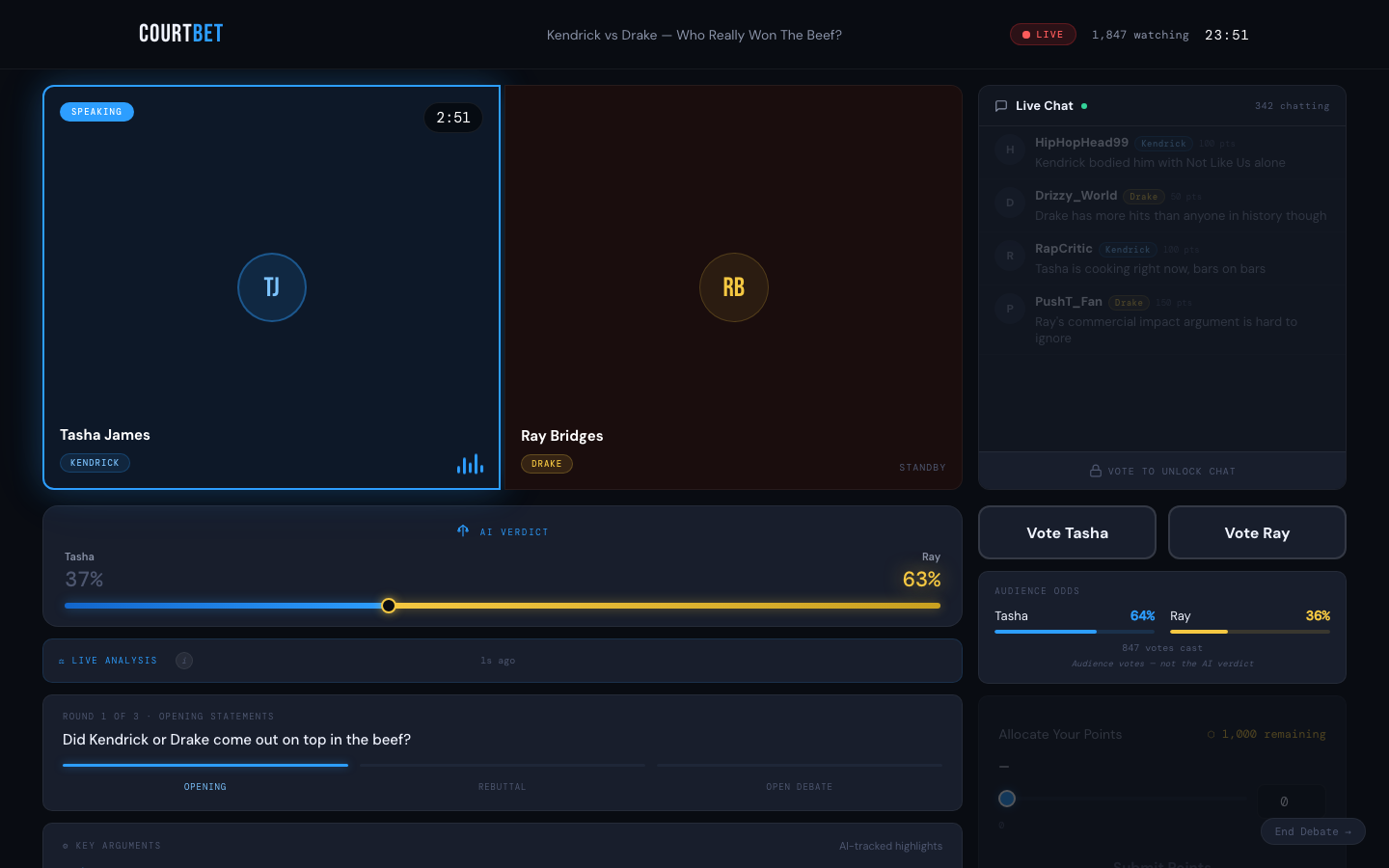
The live debate room is the whole product in one view: two speakers, a shifting AI verdict, a crowd voting and staking points, and a chat reacting to all of it.
Live screens fail when they try to show everything at once. My rule for every state: the screen must always answer two questions, what is happening right now, and what should I do next.
Where it started: the mid-fi round
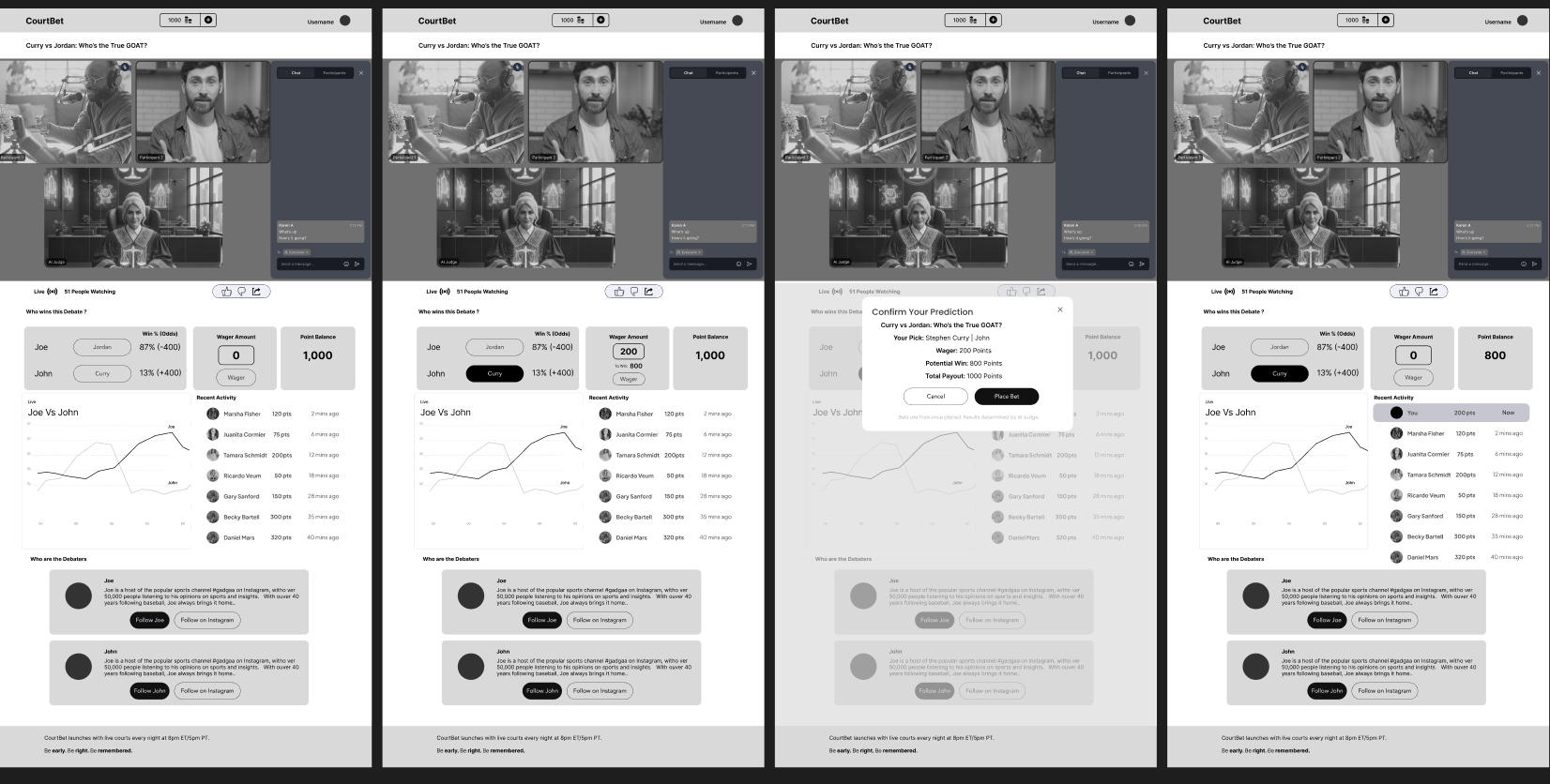
The judge as a talking head. Mid-fi put the AI judge on camera as a third participant, a literal courtroom avatar. It competed with the debaters for attention. In the final design the judge became atmosphere: a verdict bar that moves and one line of commentary, felt everywhere and staring at no one.
Sportsbook odds. Mid-fi spoke bookmaker: 87% (-400), a wager amount box, a confirmation modal. Casual viewers should not need a gambling vocabulary, so the final replaced odds with a plain-language verdict bar and a points slider, and teaches the scoring at the moment the verdict lands.
Video first, chat beside. The core stage survived every round: two faces large, the conversation next to them, the money layer below. What changed was everything around it.
One debate, four moments
These are four frozen moments of the same debate. Every time-varying element was designed per state, not left to chance.
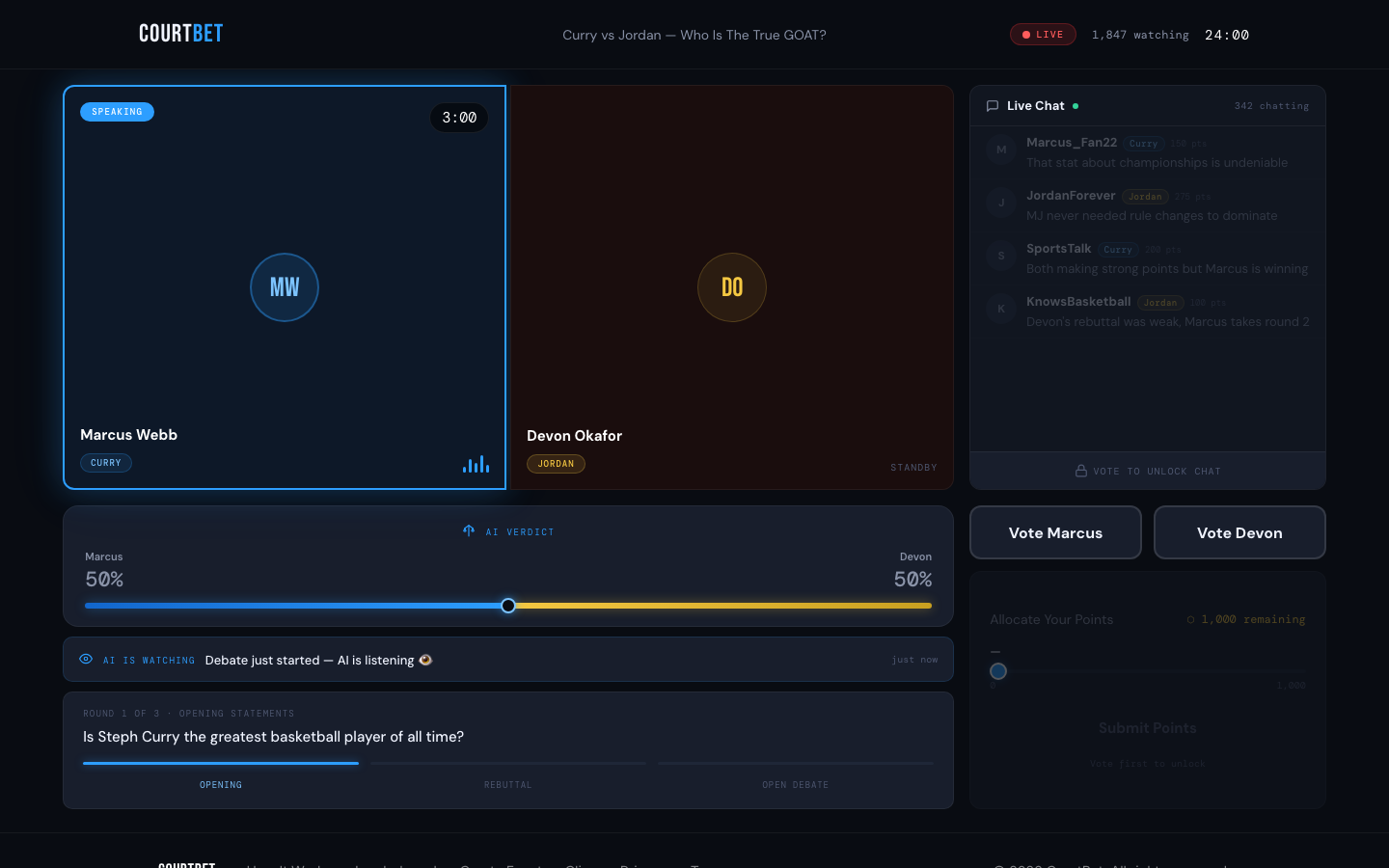
The debate begins neutral. Timers lead, the verdict bar sits at dead even, and the prompt card names the round and the question.
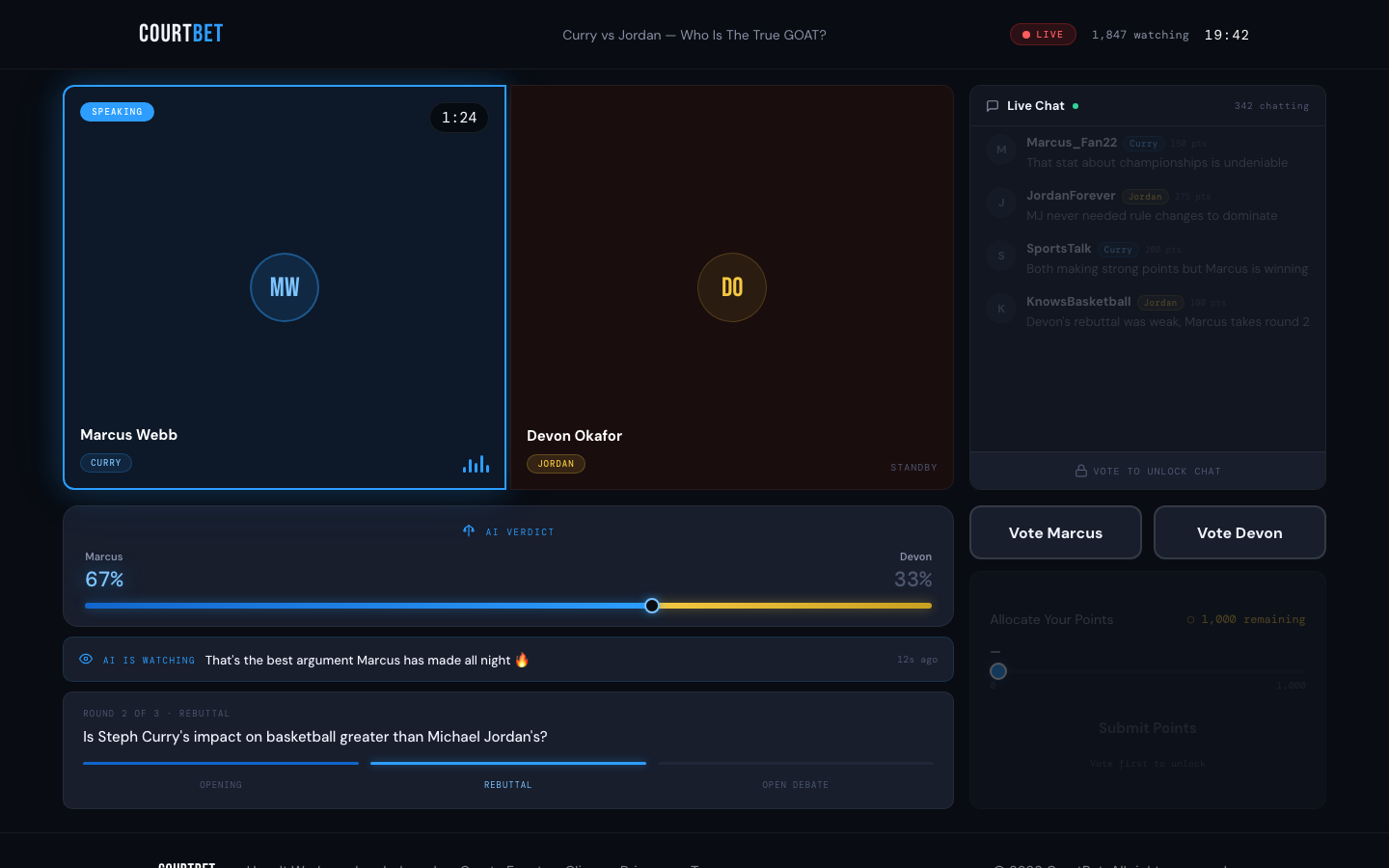
Mid-rebuttal, the AI has an opinion and the bar leans hard. The AI's commentary line updates so the shift never feels arbitrary.
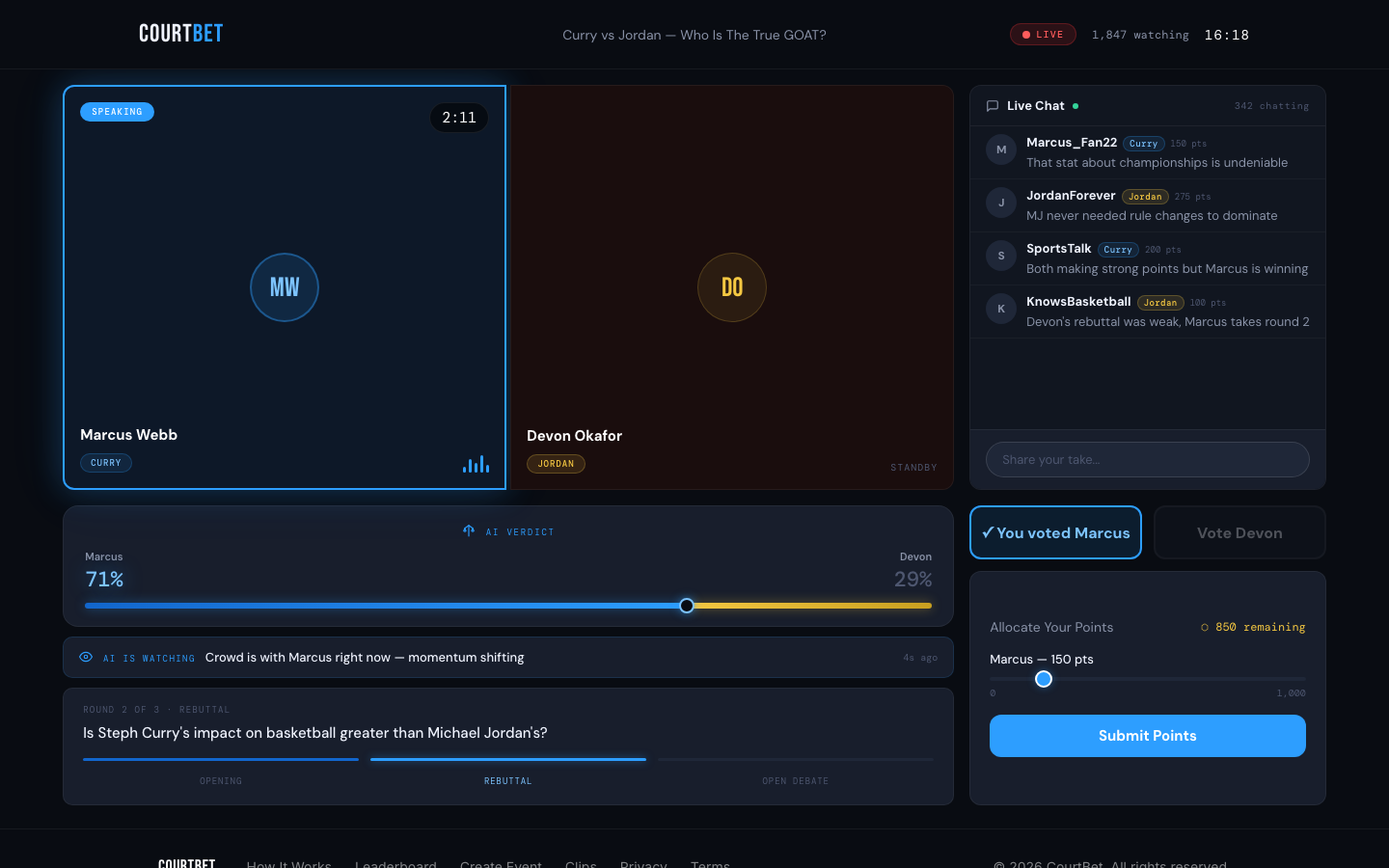
The gap widens and the crowd reacts. Chat messages carry each commenter's vote badge, so the conversation shows its allegiances.
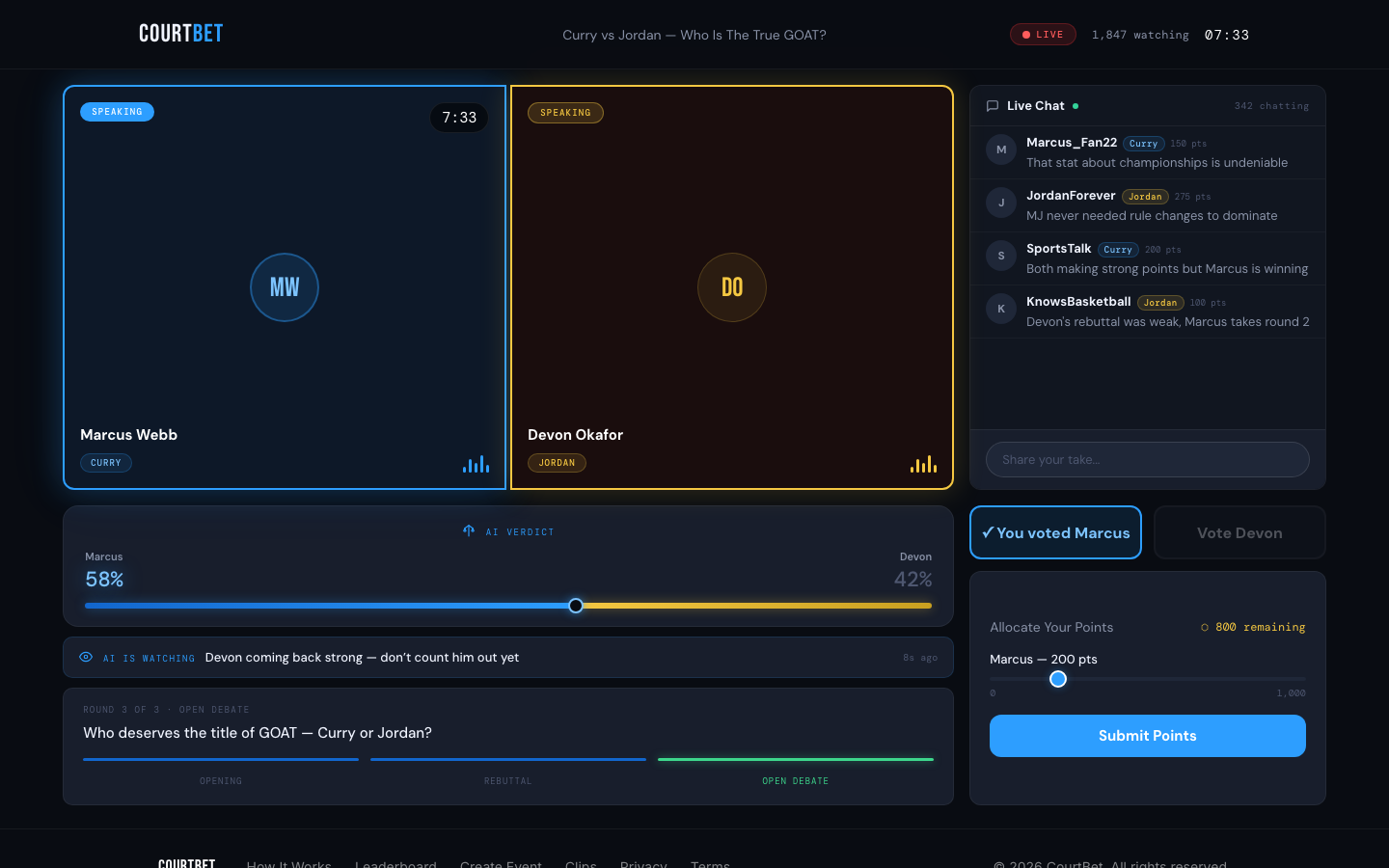
In the open floor, speaker tiles switch between Speaking and Standby, so even with the sound off you know who holds the room.
Drag it: the verdict, moving live
Voting unlocks staking, in that order. You cannot stake points until you have voted, and the points panel says so while locked. Commitment comes in steps, and the interface teaches the game's rules by refusing politely.
Feature 03 · Coverage
Every way it can end, designed.
A bet can end ten different ways: who won, how you voted, and whether the crowd was right. Each combination gets its own screen with its own copy, because winning against the crowd should feel different from winning with it.
One debate, your two endings
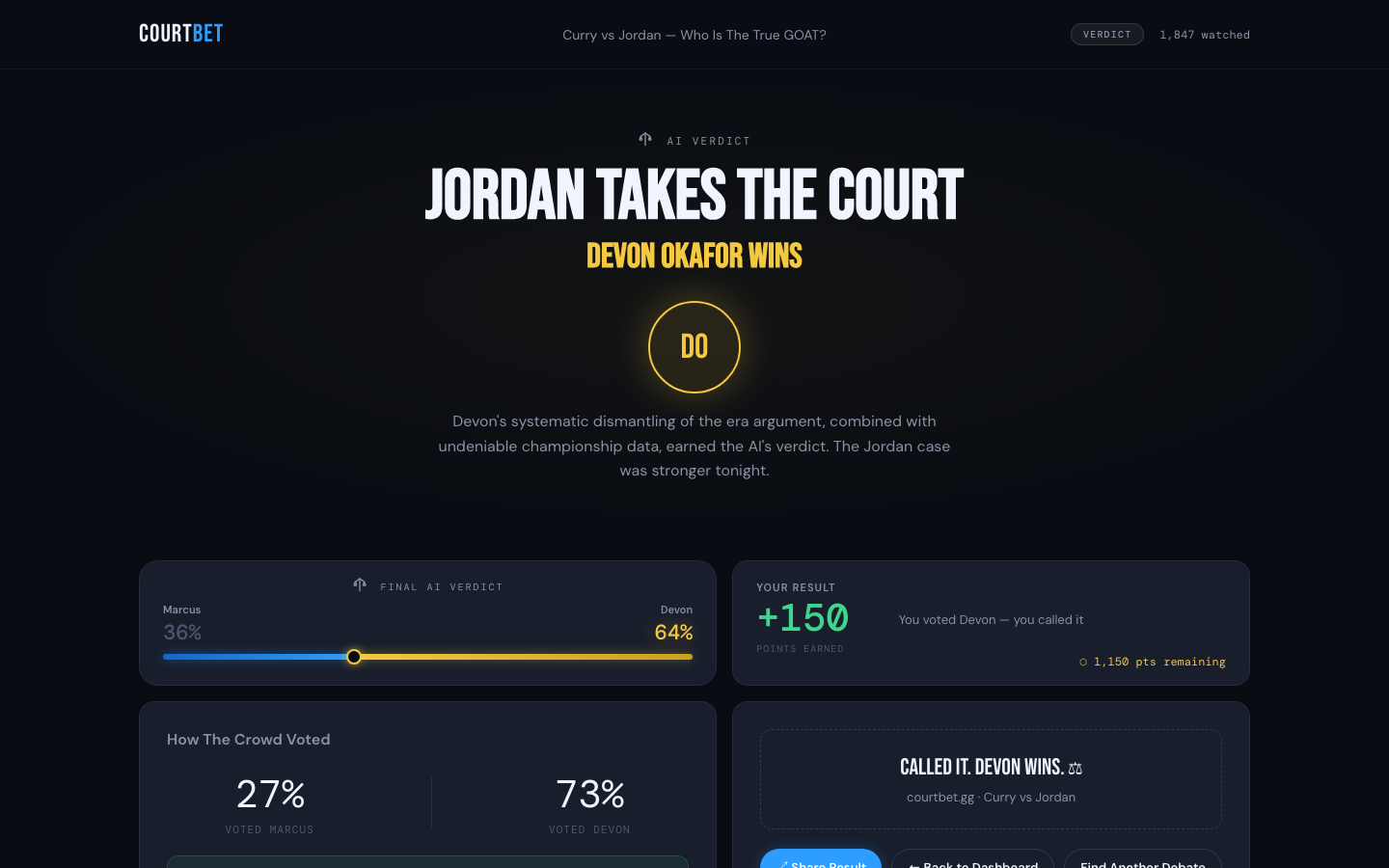
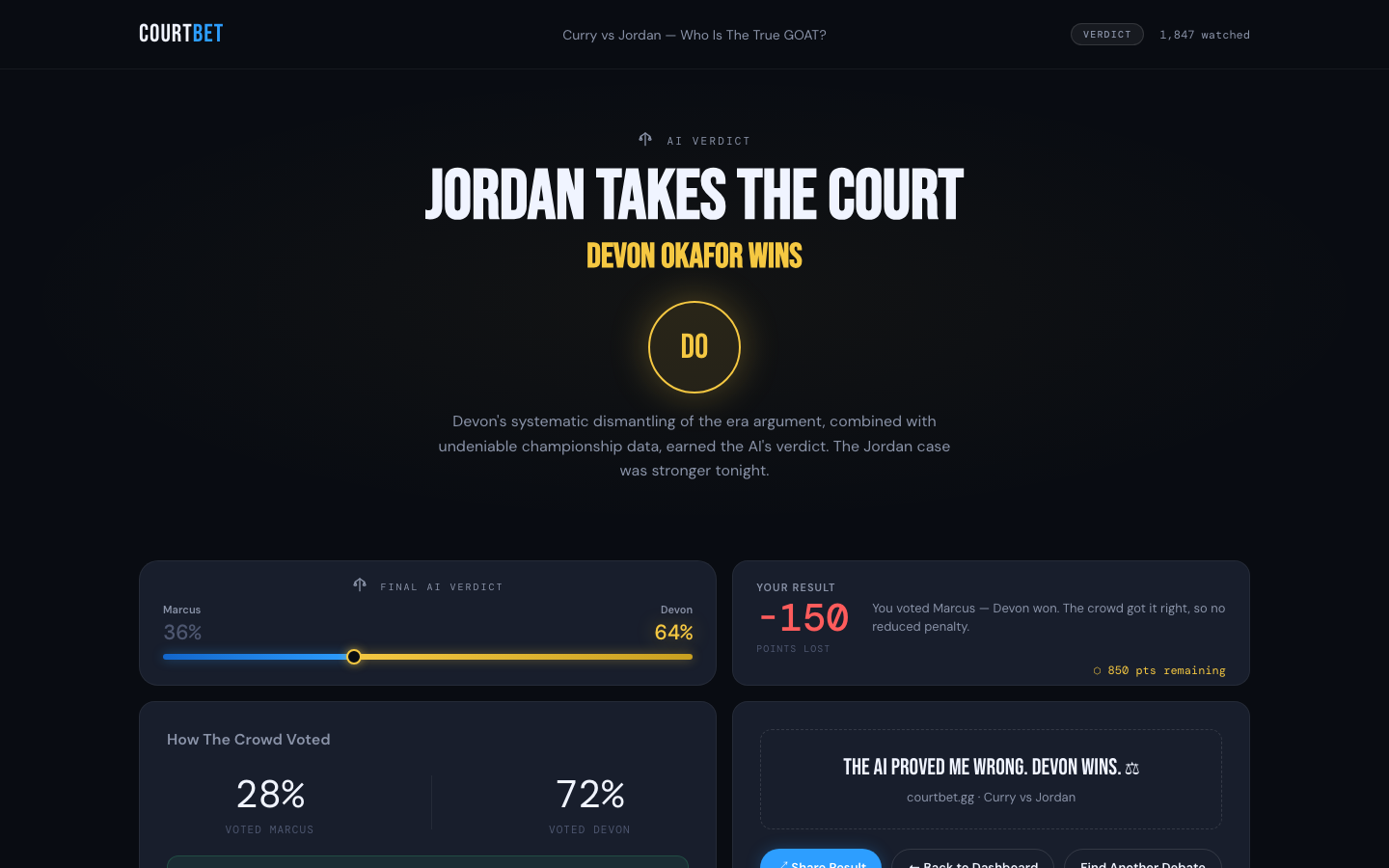
The contrarian bonus gets its own celebration. Beat the crowd and the copy says so. Lose with the crowd and the penalty is reduced, and the screen tells you why. The scoring rules are taught at the exact moment they matter.
Every ending produces a share card. Win or lose, the verdict screen generates a receipt built for group chats: "Called it," or "The AI proved me wrong. Rematch pending." The viral loop is designed into the moment of highest emotion.
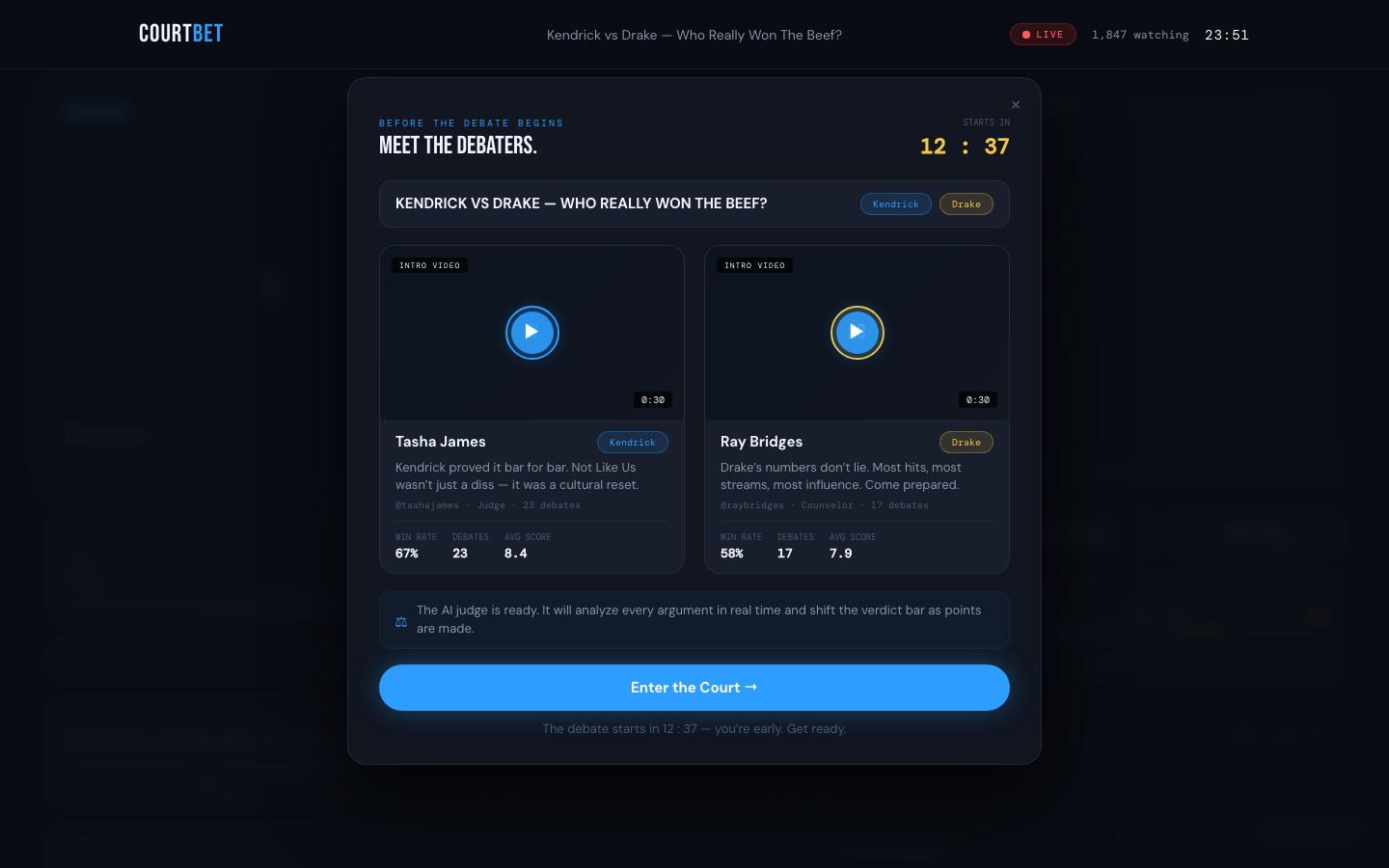
Guests get the show, not a wall. The anonymous version of the live room keeps the debate fully watchable and converts at the exact moments of intent: try to chat, try to vote, and the panel itself becomes the signup pitch with 1,000 free points attached.
Feature 04 · End to end
The parts nobody mocks up.
A debate starts days before anyone goes live: a challenge, a negotiation over time, reminders, and a reason to come back after losing. I designed the whole loop, inbox included.

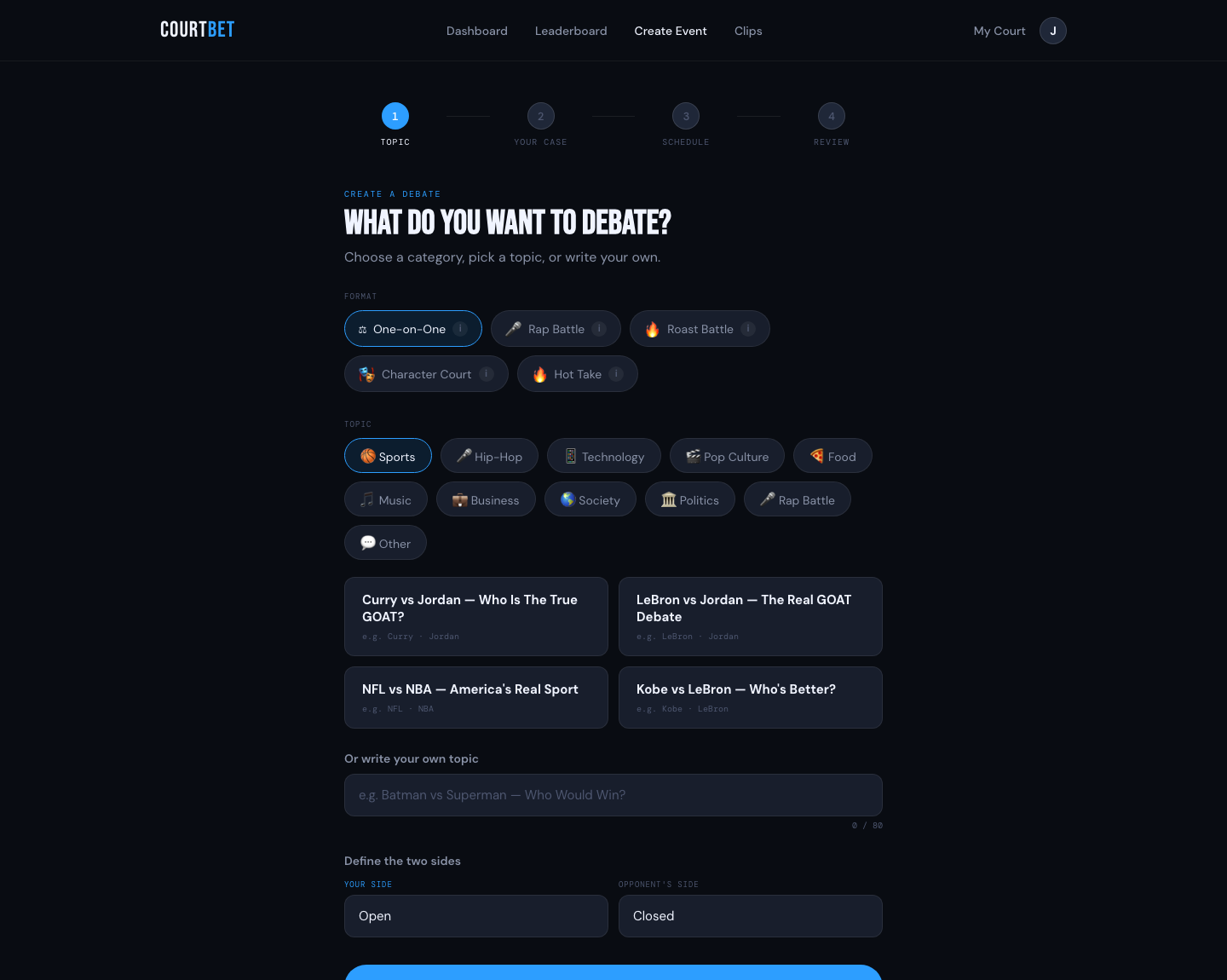
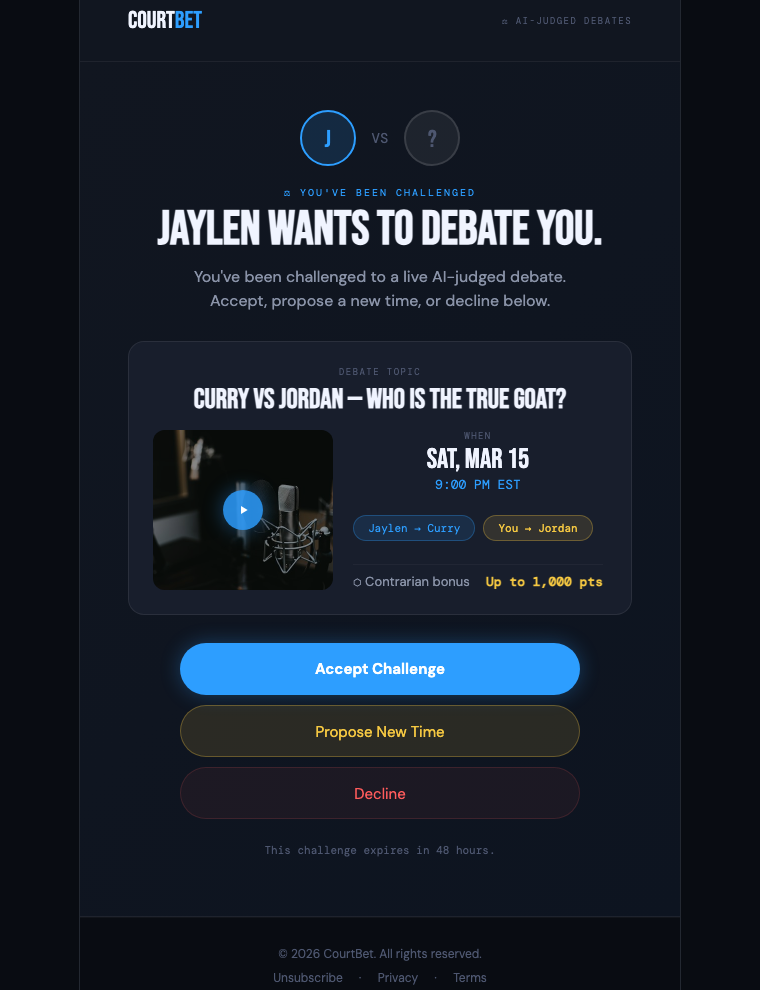
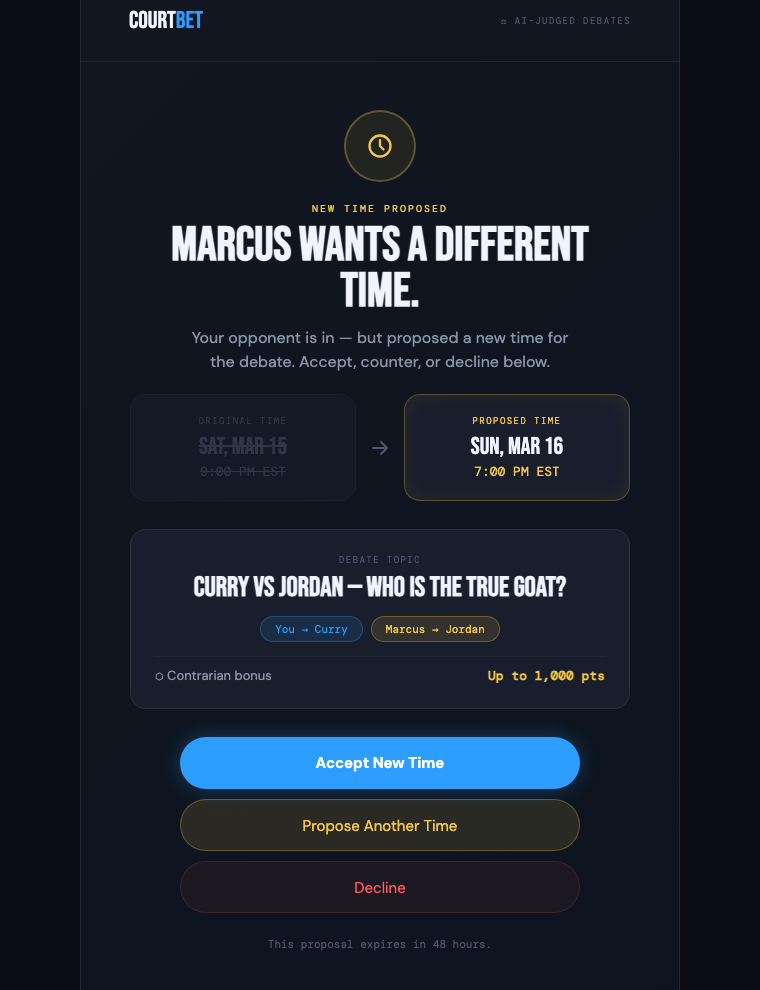
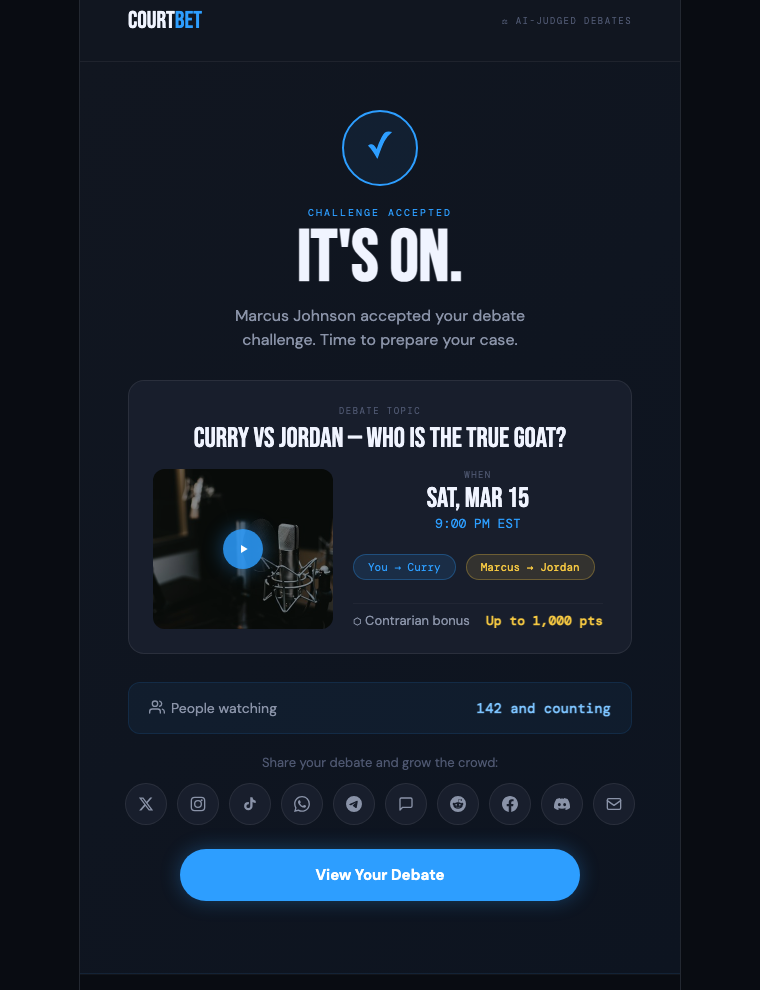
The invite shows the opponent's buttons. The wizard's final step previews the challenge exactly as the other person will receive it, accept, counter, and decline included. You never send something you haven't seen through their eyes.
Scheduling is a negotiation, so I designed one. Accept, decline, or propose a new time, and the counter-offer flows through email, dashboard, and wizard with the same three choices everywhere. One branch, three surfaces, zero dead ends.
Outcomes
What a prototype proves.
- It actually runs. The debate room works with live video, real-time speech transcription, and an AI judge that scores arguments using a rubric I wrote: argument strength, evidence, and delivery.
- The design system held. 44 screens by one person over three months, and the last screen still matches the first, because the tokens did the enforcing.
- Range, on the record. Marketing pages, onboarding, dashboards, live states, verdicts, and transactional email, one product, one designer, every layer.
- Honest status. This is a working prototype, not a launched product. No external users have tested it yet, and the numbers on these screens are demo content.
The Sentinel shows how I work with a team. CourtBet shows what I can carry alone.
Why this project is hereHow it was tested
Honestly: by building it and living in it. The room runs for real, so every design decision got tested the hard way, by using it. The AI judge's rubric was tuned by running actual arguments through it and adjusting until the scores felt earned, and a month of daily use reshaped the live room screen by screen.
What it has not had yet is people other than me. That is not a footnote, it is the next step, and it is why the reflection below says what it says.
Try it: the real screen, not a picture
What I would do differently
I would test the wager mechanic with real people before designing ten verdict screens. The contrarian bonus feels right, but "feels right" is exactly the kind of decision I now hold until someone outside my head has played with it.
And I would design mobile alongside desktop, not after. Live events get watched on phones, and a desktop-first live room is a decision the audience would have overruled.